Broken on Purpose: How Glitch Art Crawled Out of the Error Log and Into the Gallery
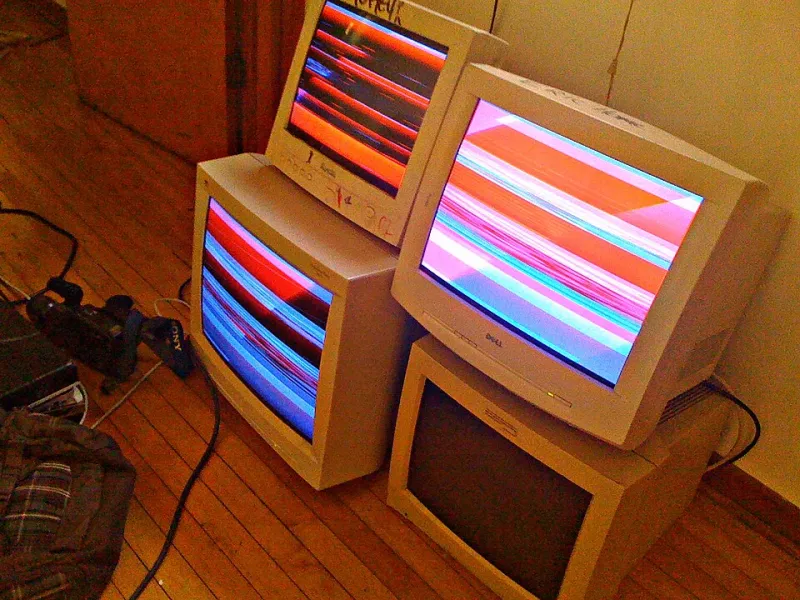
Photo: jonCates, CC BY-SA 4.0, via Wikimedia Commons
There's a specific kind of panic that hits when your screen fractures into a mosaic of scrambled pixels right before you save your work. For most people, that's a nightmare. For a growing community of digital artists, it's the whole point.
Glitch art — the practice of intentionally corrupting, bending, or breaking digital systems to produce visual output — has gone from a niche internet curiosity to a recognized artistic discipline with gallery shows, academic essays, and a dedicated global community. The journey from "did my computer just die?" to "that's hanging in a museum" is weirder and more fascinating than you'd expect.
Before It Had a Name
The roots of glitch aesthetics stretch back further than most people realize. Early video artists in the 1960s and 70s were already messing with analog signal interference, deliberately distorting television transmissions to create something that felt raw and unstable. Nam June Paik, one of the founding figures of video art, was essentially doing proto-glitch work decades before anyone had a personal computer.
But the digital version of the movement really started taking shape in the late 1980s and through the 1990s, when personal computing became widespread enough that ordinary people started encountering — and getting curious about — digital errors. Early internet culture had a natural affinity for lo-fi aesthetics. Slow connection speeds, pixelated images, and janky animations weren't bugs to be fixed; they were just the texture of the online world. Artists started noticing that texture had a kind of beauty to it.
By the mid-2000s, artists like Rosa Menkman and Iman Moradi were writing seriously about glitch as an aesthetic category. Menkman's Glitch Studies Manifesto, published in 2010, gave the movement something it had been missing: a theoretical backbone. Suddenly glitch art wasn't just people messing around with corrupted JPEGs — it was a legitimate critical practice.
The Technical Side of Beautiful Failure
So how do you actually make glitch art? The methods are as varied as the outputs, but a few techniques became foundational.
Databending involves opening a file — an image, an audio file, even a video — in software that wasn't designed to read it. Open a JPEG in a text editor, delete a random chunk of code, save it, and reopen it as an image. What comes back is unpredictable, often stunning: smeared colors, diagonal streaks, blocks of corrupted geometry. The artist controls the conditions but not the exact outcome, which creates a genuinely collaborative dynamic between human intention and machine chaos.
Circuit bending takes the concept into hardware, physically modifying electronic devices — old Game Boys, circuit boards, synthesizers — to produce unintended outputs. The sounds and visuals that come out are genuinely novel because they emerge from systems operating outside their designed parameters.
Then there's software like Audacity used on image files, or dedicated glitch tools that let artists dial in specific types of corruption. The range goes from highly controlled manipulation to near-total randomness, and artists position themselves all across that spectrum.
Why It Resonates (And Why the Art World Eventually Caught Up)
Glitch art hit differently because it was doing something emotionally honest about the digital age. We live inside systems we don't fully understand, running on infrastructure that's constantly on the edge of failure. Our photos, our messages, our entire social lives exist as data that could corrupt, disappear, or get scrambled at any moment. Glitch art makes that fragility visible.
There's also something almost punk about it. In a digital landscape obsessed with polish — perfect Instagram grids, seamless UI, 4K everything — deliberately embracing the broken and the ugly is a small act of resistance. It says the machine doesn't have to look the way the engineers intended. You can hijack it.
The art world, notoriously slow to accept digital work as "real" art, eventually came around. Institutions like the Museum of Arts and Design in New York started incorporating digital and new media art into their programming. Artists like Cory Arcangel built careers out of manipulating obsolete technology and corrupted systems. The Whitney Biennial and other major showcases began including work that would have been dismissed as computer errors a decade earlier.
MTV's visual language in the early 2000s borrowed heavily from glitch aesthetics without necessarily knowing it. Music video directors started using digital artifacts as stylistic choices. The look filtered into fashion photography, graphic design, and eventually mainstream advertising — which, depending on who you ask, either validated the movement or killed it.
The Voidframe Angle: Art That Eats Itself
What makes glitch art genuinely interesting from where we're sitting — somewhere at the edge of digital culture, watching patterns form and dissolve — is that it's one of the few art forms that uses its medium against itself. Photography documents reality. Film constructs narrative. Glitch art takes the digital image and corrupts it from within, using the same tools that created it to unmake it.
There's a philosophical dimension there that's hard to ignore. Every glitched image is a kind of memento mori for the digital age — a reminder that the files you're saving, the memories you're storing in the cloud, the carefully curated content you're putting out into the world, all of it exists in a state of permanent potential failure. The glitch just makes that visible for a second.
Where It's Going
AI-generated imagery has introduced new wrinkles. Early AI image generators produced their own distinctive glitches — extra fingers, melting faces, impossible geometries — and artists immediately started incorporating those artifacts into their practice. The conversation between human artists and machine systems has gotten more complex, and glitch aesthetics are right in the middle of it.
VR and mixed reality are opening up new territory too. What does a glitch look like when it's happening inside a space you're inhabiting? Artists are starting to explore that question, and the answers are predictably disorienting.
Glitch art is also deeply embedded in internet subcultures that are constantly evolving. Vaporwave pulled heavily from glitch aesthetics. So did the seapunk moment, the lo-fi hip hop visual universe, and dozens of micro-aesthetics that bloom and fade on platforms like Tumblr and TikTok. The movement keeps finding new hosts.
Somewhere right now, someone is opening a video file in the wrong software and watching something strange and beautiful crawl out of the corruption. The error log is still generating art. It probably always will.