The Sound of Logging Off: Who's Recording the Web Before It Goes Quiet
Photo: R. Henrik Nilsson, CC BY 4.0, via Wikimedia Commons
The handshake
There is a folder somewhere on a hard drive in the Midwest that contains nothing but the sound of the internet connecting to itself.
You can hear the whole arc in it. The dial tone, that flat and patient hum. The touch-tone burst. Then the negotiation — the shrieking, the hiss, the two machines feeling each other out like animals in the dark. And then, if you wait long enough, the small clunk that meant you were in.
For anyone who was online before roughly 2005, that noise isn't nostalgia. It's a door opening. It's the sound of the world getting bigger in the next thirty seconds.
The person who keeps that folder isn't running a museum. They're a self-taught archivist with a decent microphone, a folder of old hardware, and a nagging feeling that we documented the look of the early web exhaustively and its sound almost not at all.
An archive made of noises
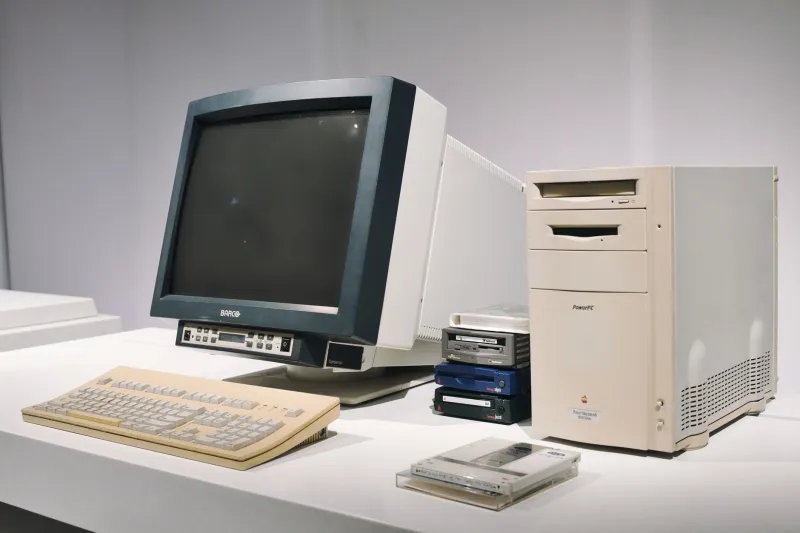
The work is scattered and mostly unfunded, which is how most preservation work starts. University librarians carve out time between cataloging projects. Sound designers keep personal libraries of interface audio that date back to software they can no longer run. A few people hunt down the original machines just to hear the fans and the drive spin up, because a recording of a computer is only half the sound of a computer in a room.
What ends up in these collections is oddly specific.
The dial-up handshake, obviously. But also: the AM-era notification ping from a messaging client nobody can install anymore. The chime of a laptop booting an operating system that's now a screensaver joke. The particular clack of a keyboard from 1998, recorded close enough to hear the spring. The squeak of a mouse wheel. The compressed air horn of a video call joining. The unsigned lo-fi loop of a social platform's loading screen, the one that played for two seconds every time you refreshed and that you can now only hear in a YouTube compilation with 40,000 views.
And then there's the room tone — the hum of a machine that's on, the fan whine in the background of every voice memo from 2009. Nobody records that on purpose. It's the thing archivists end up saving by accident, and it's the thing that makes a recording feel like a place.
Why the ear remembers better than the eye
Screenshots get shared constantly. We've all seen the dead interfaces: the blue-gray of a discontinued messenger, the pixelated icons, the layouts that look like a different civilization. But a picture of an interface is evidence. A sound is a memory.
There's a reason for that. Audio hits differently — faster, lower, less filtered by the part of the brain that checks whether a claim is accurate. Hear a keyboard you used to type on and you don't think I recognize that. You feel your hands at the desk.
Designers have leaned on this forever without admitting it. The classic Mac startup chime, famously assembled as a single resolving chord, was engineered to make turning on a machine feel like arriving somewhere. Decades later, engineers still argue about whether the sound of a device should be a major interval or a warning. That debate is not about audio. It's about whether a piece of technology welcomes you or asks you to be careful.
The web went quiet on purpose
Here's the uncomfortable part: we didn't lose the sound of the internet. We turned it off.
Autoplay never really got fixed — it got suppressed. Browsers started blocking audio until you interact with the page, and the entire web responded by assuming the speakers were dead. Sound became opt-in, tucked behind a tap to unmute button, treated as an annoyance that a good user experience should prevent. Silent video became the norm. Headphone-less scrolling became polite.
That's mostly a gift. Nobody misses a banner ad screaming at them. But it also means the web stopped composing itself. A site today can look like anything and sound like nothing, which is a strange trade to have made without really discussing it. We isolated the nuisance and, in the process, threw out the texture.
Contextual sound in games survived the purge, and that's not a coincidence — games are one of the few places where a sound is understood as information rather than interruption. Everything else got muted at the browser level and never asked to come back.
What a sound collection is actually for
The people doing this work rarely frame it as nostalgia. They frame it as documentation. A screenshot tells you what an interface looked like; a recording tells you how long it took to load, how the machine felt about it, and whether the room was warm.
There's also a practical angle. Sound designers need reference material. Preservationists restoring old software need the right chime, not a modern approximation of it. Researchers studying attention and interface design want to know what a notification actually sounded like before every platform converged on the same three-note chime with the same gentle decay.
And then there's the version nobody says out loud: these archives exist because the platforms won't keep their own ghosts. Companies sunset servers. Servers delete audio assets without ceremony. A loading loop that played a billion times can vanish in a deploy, and there is no department whose job is to say wait, record that first.
The silence at the end of the hall
Most of the internet now ends with a fade, not a click. Notifications arrive silently. Videos play muted until asked. Apps close with no sound at all, which is the quietest possible way to leave.
That's fine, mostly. Clean. Considerate. But it means the archive in that Midwest hard drive is holding something increasingly rare: evidence that this whole thing used to make noise. That it hummed and shrieked and chimed and had a room tone.
A screenshot shows you a dead website. A recording lets you hear the room it died in.