Static as a Love Language: Why Designers Keep Breaking Their Perfect Pixels
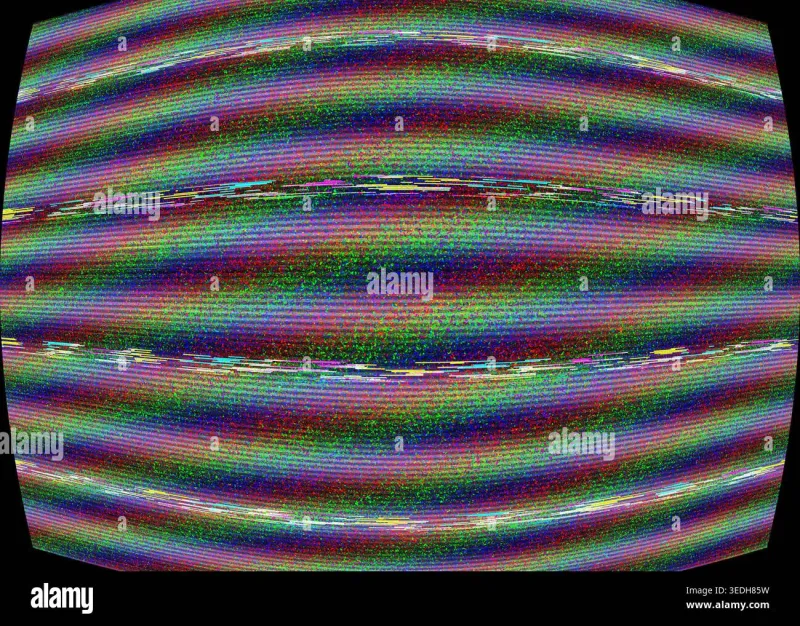
Photo: VHS static noise glitch television screen analog, via c8.alamy.com
There's a video that's been circulating on my feed for months. It's shot on VHS — or something dressed up to look like it — tracking lines wobbling through the frame, colors bleeding at the edges, audio hissing underneath a synth loop like a radio caught between stations. It has no message. It barely has a point. It has 2.3 million views.
Nobody in the comments is asking why it looks this way. They already know. They grew up in the era of fiber optics, and they're nostalgic for the static.
The Cleanest Screens Ever Built
Here's the irony sitting at the center of this whole aesthetic movement: we have never had less noise in our lives. Your grandmother's television had to be tuned. Your parents' dial-up connection announced itself with a shriek before it let you into the world. Every analog signal came with friction baked in — hum, grain, drift, dropout.
Today? Your 4K stream arrives immaculate. Your phone's camera scrubs out every blemish before you even see the photo. The modern digital experience is a sealed, frictionless tube, and somewhere around 2018 or so, a lot of creative people started to find it suffocating.
So they started adding the noise back.
Interference as a Design Choice
Look closely at the visual language of the moment and you'll see it everywhere. Album covers that look like they were photocopied eleven times. Music videos shot on camcorders with the timecode left running. Brand identities for streetwear labels built around scan lines, chromatic aberration, and the specific green-gray of a CRT monitor's glow.
There's a whole tooling ecosystem behind this. Designers run pristine footage through degradation plugins that simulate tape warp and signal loss. Musicians route clean digital synths through busted cassette decks and bitcrushers just to hear them crackle. Online communities trade presets for making things look worse — deliberately, artfully worse — the way previous generations chased higher fidelity.
Why? A few theories worth taking seriously.
Noise reads as proof. A degraded signal implies a physical object existed somewhere — a tape, a broadcast, a moment that actually happened. In a feed full of infinite, weightless, AI-suspect content, grain feels like evidence. It whispers: a human touched this.
Flawlessness feels like a sales pitch. We've all been trained to associate glossy, optimized visuals with advertising. Static is the visual equivalent of a shrug. It doesn't want your wallet; it wants your attention for a second and then it'll let you go.
Analog noise has texture that digital doesn't. Film grain is random in a way algorithms struggle to fake, which is exactly why algorithms are now being asked to fake it. There's a feedback loop forming: the more synthetic the mainstream gets, the more valuable the genuinely imperfect becomes.
The Nostalgia That Isn't Quite Nostalgia
Here's where it gets interesting. Most of the people making this work never lived with analog technology. They didn't rewind tapes or blow into cartridges. Their nostalgia is inherited — a secondhand longing for an era they only know through fragments.
And honestly, that might be the point. The static isn't really about the past. It's about contrast. When everything in your environment is smooth, optimized, and personalized to the decimal, the tiniest bit of interference feels like relief. It's the digital equivalent of leaving the city to hear actual silence — except in reverse. We leave the silence of the perfect feed to hear actual noise.
There's also a subtle act of resistance embedded in it. Degraded media is hard to compress, hard to scale, hard to template. A VHS-filtered brand identity can't be churned out by a content pipeline. Choosing roughness is a way of opting out of the optimization arms race, even just aesthetically.
When the Noise Becomes a Template
Of course, this is still the internet, and the internet eats its own counterculture for breakfast. The static aesthetic is already being packaged — filter packs, one-click degradations, templates that let anyone slap authenticity onto anything. The grain is available as a subscription.
That doesn't kill the impulse, but it does complicate it. There's a difference between a musician who genuinely recorded to a four-track because they liked the hiss, and a brand deck that adds scan lines because the focus group responded to them. The signal gets harder to read the more people learn to fake it.
Maybe that's fitting. The whole aesthetic is about signals fighting through interference, after all. The real stuff still cuts through — you just have to listen a little closer.